
Introduction
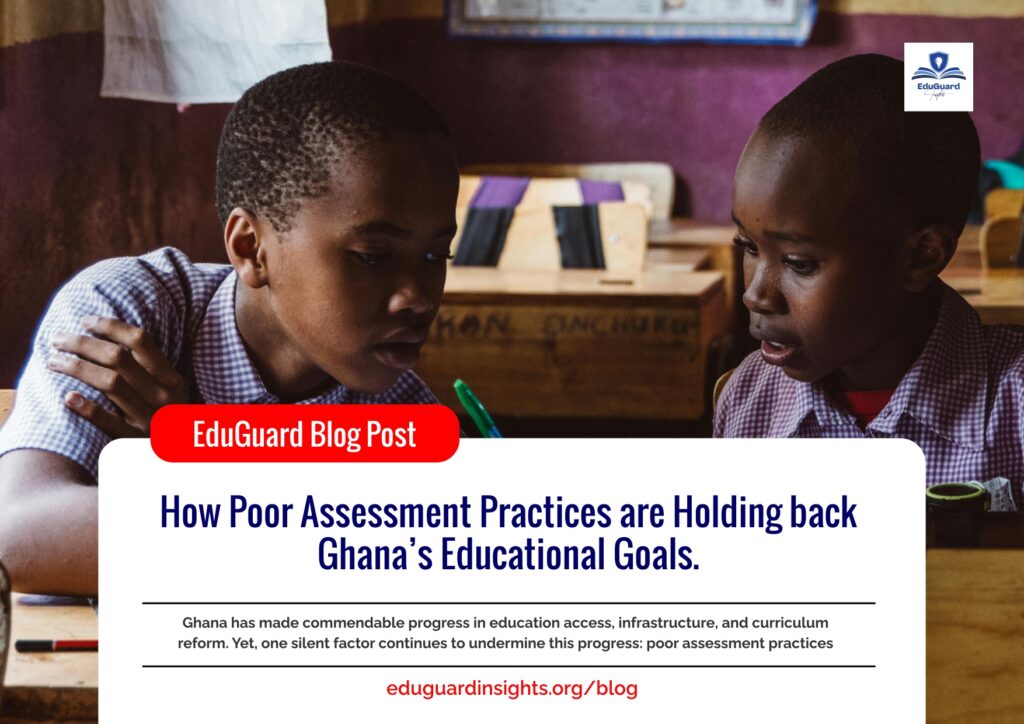
Ghana has made commendable progress in education access, infrastructure, and curriculum reform. Yet, one silent factor continues to undermine this progress: poor assessment practices. Misaligned tests, lack of feedback, and one-size-fits-all assessments directly impact performance and equity.
What Does Poor Assessment Look Like?
Repetition of the same test types each term
No clear grading criteria or feedback loops
Tasks that don’t reflect real-life applications
Uniform tests for diverse learner needs
The Impact on Learners
When assessments don’t reflect what was taught—or how students learn—they become disengaged. In rural areas with limited supervision, this effect is worse, widening the achievement gap between urban and rural students.
The National Perspective
Ghana’s Education Strategic Plan (ESP 2018–2030) recognizes the need for quality assessment. Yet, gaps remain:
Many teachers lack training in updated assessment methods
Continuous Professional Development (CPD) is missing in many schools
EduGuard’s Role in Fixing the Gap
Through NEASS (National Educational Assessment Support Series), EduGuard is auditing and supporting schools to:
Align tests with learning goals
Use diagnostic tools in lesson planning
Introduce performance-based assessments
Promote feedback-rich practices
Call to Action
To meet both national and global education targets, Ghana must address this “silent saboteur” in classrooms. Assessment literacy should be a core competency for every teacher.
Conclusion
Assessment is not just a teaching tool—it’s a justice issue. It decides who advances and who’s left behind. Reforming it is not optional—it’s urgent.
