Introduction
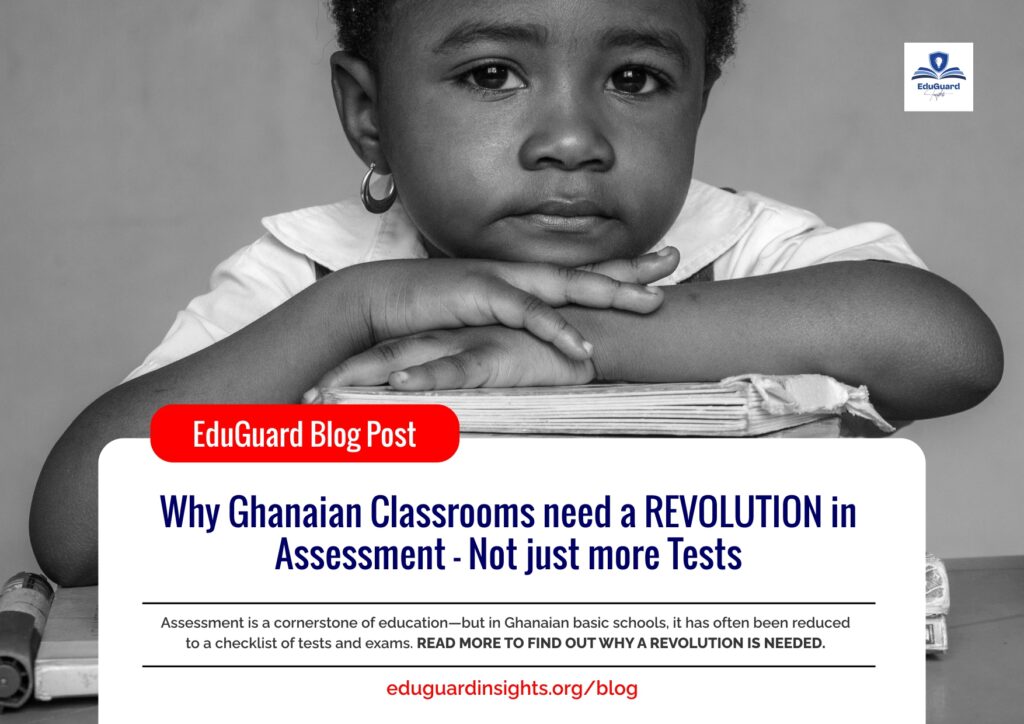
Assessment is a cornerstone of education—but in Ghanaian basic schools, it has often been reduced to a checklist of tests and exams. While assessments are necessary for evaluating learning, the real crisis lies in how we assess, not how often. EduGuard Insights explores why Ghanaian classrooms need a revolution in educational assessment—one rooted in learner growth, not grades.
The Problem with Traditional Assessments
In many public and private schools, the primary method of evaluation is through end-of-term exams, often designed to test memorization rather than understanding. Teachers may be pressured to “complete the syllabus” and conduct a “standard test,” with little room for innovation. This leads to:
-
Surface learning instead of deep understanding
-
Pressure on learners to cram for tests
-
Teachers struggling to differentiate instruction
The Problem with Traditional Assessments
Unlike “Assessment OF Learning” which occurs after teaching, Assessment FOR Learning is formative and ongoing. It helps identify learning gaps early. Examples include:
-
Exit tickets and reflective journals
-
Peer assessment and group rubrics
-
Concept mapping and observation checklists
Why It Matters in Ghana’s Context
Ghana’s standard-based curriculum emphasizes critical thinking, creativity, and problem-solving. Without evolving assessment methods, we risk teaching 21st-century content with outdated tools. Competency-based assessment isn’t optional—it’s essential.
The Way Forward
-
Train teachers in modern assessment strategies (e.g., via NEASS)
-
Align classroom assessments with curriculum outcomes
-
Empower learners through peer/self-evaluation
-
Guide school heads in data-driven decision-making
Conclusion
Assessment should not be a hammer that crushes creativity—it should be a lens that magnifies learning. It’s time for Ghanaian schools to embrace a new era of assessment focused on understanding, growth, and learner potential.
